- Home
- Technologies
- MJF 3D Printing (HP Multi Jet Fusion)
MJF 3D Printing (HP Multi Jet Fusion)
MJF (HP Multi Jet Fusion) is an industrial 3D printing technology that fuses a layer of polymer powder using a fusing agent and infrared heat. It produces dense, strong, near-isotropic PA12 and PA11 nylon parts without supports – suitable for functional prototypes and series production.
One of the fastest and most cost-effective technologies for nylon parts – from a single prototype to batches of hundreds.
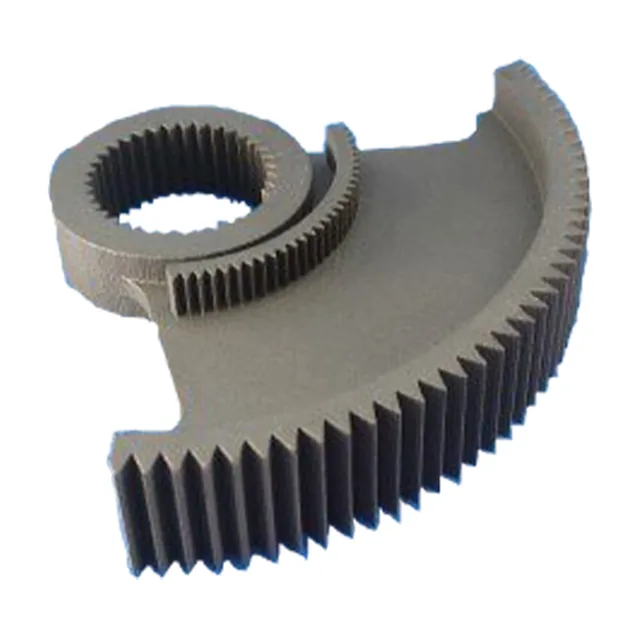
Choose MJF when you need
- Functional prototypes that behave like moulded parts
- Small and medium batches (10–1,000+ units) without tooling
- Housings, brackets, snap-fits, hinges and assembled mechanisms
- Complex shapes: internal channels, lattices, openwork structures
- On-demand spare parts
Strengths
- Strong, dense, near-isotropic parts
- No supports needed – design freedom
- Fast and cost-effective for batches
- Excellent for black dyeing
Limitations
- Matte, slightly grainy surface
- Natural colour is grey (white or colour only with certain materials)
- Large flat surfaces may warp
- Build volume limited to 380 × 380 × 284 mm
MJF materials
Properties from material datasheets. Click a material for full data and design recommendations.
Strong, versatile, ideal for batches
More flexible, more impact resistant
Lightweight, chemical resistant
Flexible, elastic, wear resistant
Stiffer, more dimensionally stable
Full-colour PA12 parts
Property table for all MJF materials
| Property | PA12 (MJF) | PA11 (MJF) | PP polypropylene (MJF) | TPU 88A/90A (MJF) | PA12 GB with glass beads (MJF) | CB PA12 Full Color (MJF) |
|---|---|---|---|---|---|---|
| Technology | HP Multi Jet Fusion (MJF) | HP Multi Jet Fusion (MJF) | HP Multi Jet Fusion (MJF) | HP Multi Jet Fusion (MJF) | HP Multi Jet Fusion (MJF) | HP Multi Jet Fusion (MJF) |
| Tensile strength | 48 MPa | 52 MPa | 25 MPa | to be confirmed | 30 MPa | to be confirmed |
| Elongation at break | 15–20 % | 35–50 % | to be confirmed | 240 % | 10 % | to be confirmed |
| Tensile modulus | 1700–1800 MPa | 1800 MPa | 1400 MPa | — | 2500–2700 MPa | to be confirmed |
| Flexural strength | 48 MPa | 52 MPa | 25 MPa | to be confirmed | 30 MPa | to be confirmed |
| Service temperature (max) | 175 °C | 185 °C | 70 °C | 100 °C | 175 °C | to be confirmed |
| Hardness (Shore) | 80D | 80D | 80D | 88–90A | 82D | to be confirmed |
| Colours | grey, black, white | grey, black, white | grey, black | grey, black | grey | full colour |
| Max. dimensions | 380 × 380 × 284 mm | 380 × 380 × 284 mm | 380 × 380 × 284 mm | 380 × 380 × 284 mm | 380 × 380 × 284 mm | 380 × 380 × 284 mm |
| Accuracy | ±0.3 mm or ±0.3 % | ±0.3 mm or ±0.3 % | ±0.3 mm or ±0.3 % | ±0.3 mm or ±0.3 % | ±0.3 mm or ±0.3 % | ±0.3 mm or ±0.3 % |
| Min. wall | 0.75 mm (down to 0.5 mm) | 0.75 mm (down to 0.5 mm) | 0.75 mm (down to 0.5 mm) | 0.75 mm (down to 0.5 mm) | 0.75 mm (down to 0.5 mm) | 0.75 mm (down to 0.5 mm) |
| Production time | up to 7 business days · express up to 4 | up to 7 business days · express up to 4 | up to 7 business days · express up to 4 | up to 7 business days · express up to 4 | up to 7 business days · express up to 4 | up to 7 business days · express up to 4 |
| Relative price | €€€€ | €€€€ | €€€€ | €€€€ | €€€€ | €€€€ |
| Datasheet |
Made with MJF
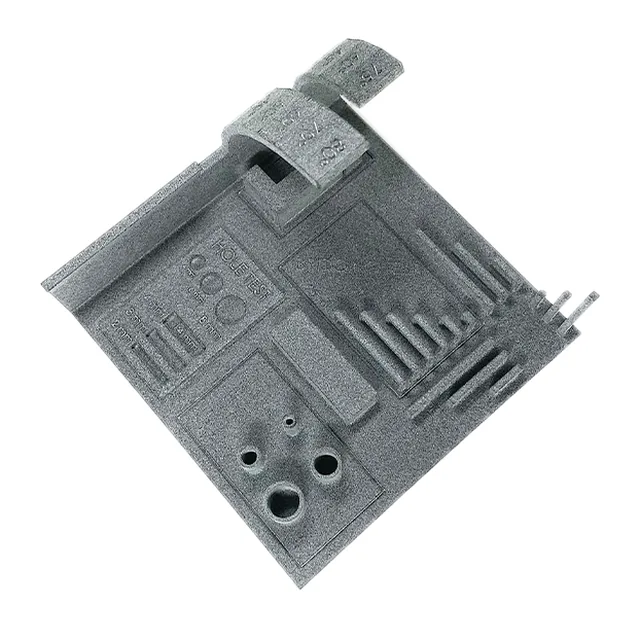
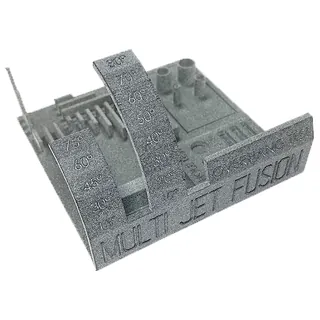
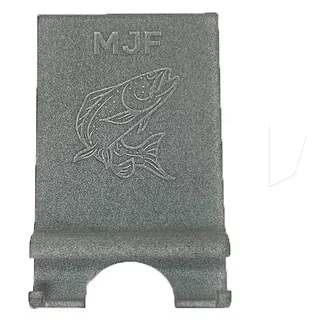
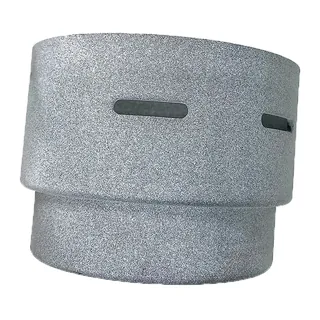
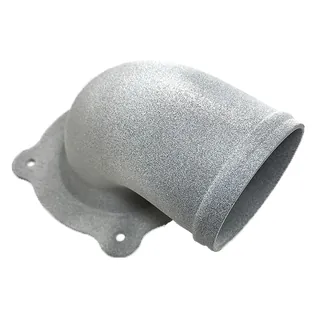
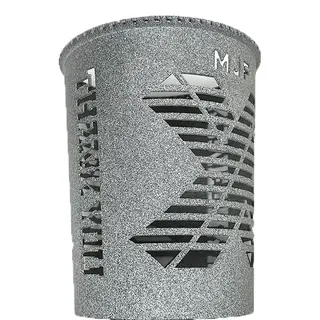
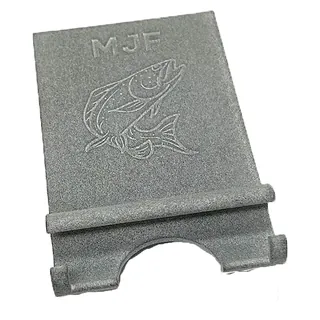
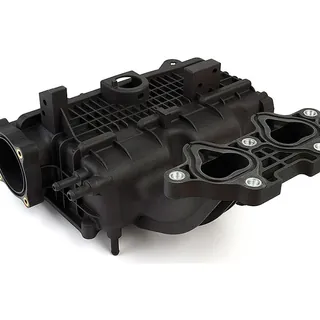
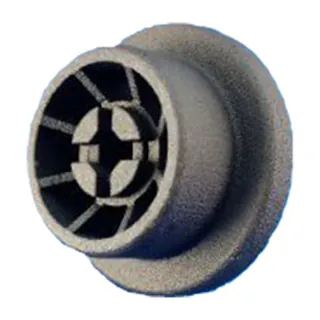
How MJF works
A thin (80 µm) layer of polymer powder is spread across the build chamber. Print heads jet a fusing agent where the part will be and a detailing agent around its contour. An infrared energy source then passes over the layer: powder with fusing agent absorbs more energy and fuses, while the surrounding powder stays loose. The detailing agent creates a precise temperature difference at the contour – the result is sharp edges and crisp fine features.
Each layer is fused in a few seconds, which makes MJF one of the fastest industrial 3D printing technologies. Unused powder supports the parts, so no support structures are needed, and the whole chamber volume can be filled with tens or hundreds of parts.
Why MJF parts are strong
- Density close to 100 % – mechanical properties close to injection-moulded plastic.
- Near-isotropic properties – similar strength in all directions, because the fusing agent is applied in every layer.
- 1200 dpi resolution in XY and 80 µm layers – fine details and thin features (down to ~0.6 mm in structures).
When MJF is most cost-effective
MJF pricing is driven mainly by material usage and the chamber space a part occupies, not by machine time. That makes it particularly suited to:
- small and medium batches – tens or hundreds of parts in one build;
- complex shapes – internal channels, lattices and assembled mechanisms do not drive up cost the way they do in machining;
- spare parts – produced on demand, with no inventory.
For batches of 300–1,500 units, MJF is often more cost-effective than injection moulding because no tooling is needed. More: 3D printing vs injection moulding.
Surface and finishing
The MJF surface is matte and slightly grainy; the natural colour is grey. Standard finishing (depowdering and glass bead blasting) is included. Parts take black dye very well; chemical or vibratory smoothing, spray painting and threaded inserts are also available.
Designing for MJF
- Minimum wall – 0.75 mm, down to 0.5 mm for some structures; for load-bearing walls, choose 1.5–2 mm or more.
- Leave at least one 2–3 mm opening in closed cavities to remove powder.
- Separate moving parts need clearances of at least 0.5–1 mm.
- Large flat surfaces may warp – reinforce them with ribs.
More in the design guide.
Finishing options
Standard finishing is included. Choose extras in the configurator – price and lead time update instantly.
Standard finish included
Removal of excess material and glass-bead blasting (powder technologies), support removal (SLA, FDM).
no extra time
Dip dyeing (black)
The part is immersed in a dye bath – an even, deep black that does not fill in fine details.
+1 business days
Spray painting
Priming and spray painting in the colour of your choice.
+3 business days
Chemical smoothing
The surface is smoothed chemically – lower roughness, easier to clean, a better sealed surface.
+2 business days
Vibratory polishing
Parts are ground in abrasive media – a uniformly smoother surface and rounded edges.
+1 business days
Threaded inserts
Metal threaded inserts are heat-set into prepared holes. Specify the quantity per part.
+1 business days
Thread tapping
Threads are cut directly into the plastic in prepared holes. Specify the quantity and thread size in the notes.
+1 business days
Sealing / lacquering
The surface is lacquered or impregnated – for tightness, moisture resistance and gloss.
+1 business days
MJF – frequently asked questions
What is MJF 3D printing?
MJF (Multi Jet Fusion) is a powder bed fusion technology developed by HP. Print heads jet fusing and detailing agents onto a layer of polymer powder, and an infrared energy source fuses it. The result is dense, strong parts without supports.
Which materials are available for MJF?
PA12 (the most common), PA11, glass bead-filled PA12 (PA12 GB), polypropylene (PP), TPU elastomer and full-colour CB PA12.
How accurate is MJF?
Typical accuracy is ±0.3 mm or ±0.3 % (whichever is greater). Layer thickness is 80 µm and XY resolution is 1200 dpi.
MJF or SLS – which should I choose?
Both produce strong nylon parts without supports. MJF is often cheaper for batches and gives a denser part; SLS has a larger build volume and a wider choice of specialist materials. Upload your model to compare prices for both.
Are MJF parts heat resistant?
The service temperature of PA12 is up to ~175 °C and of PA11 up to ~185 °C (per datasheets; depends on load). For long-term high-temperature use, consult an engineer.