PA12 Nylon
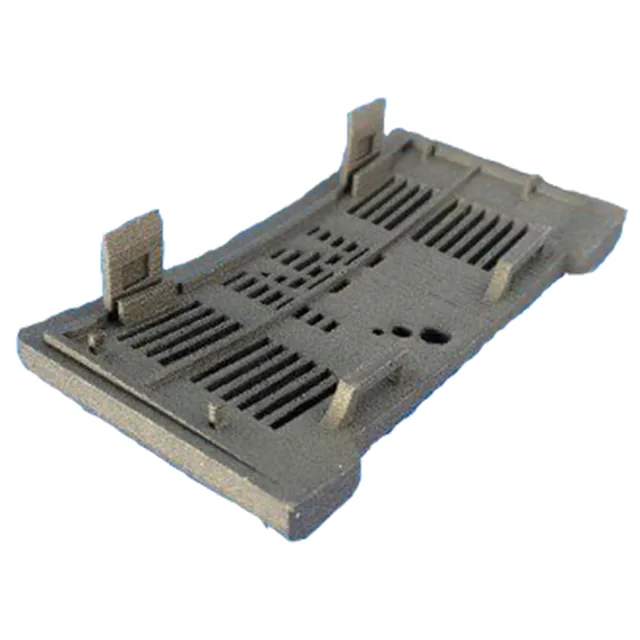
PA12 (polyamide 12, nylon 12) is one of the most widely used engineering plastics in 3D printing: mechanically strong and resistant to chemicals and heat. Produced with MJF and SLS – suitable for functional prototypes and end-use parts.
Properties by technology
Values from manufacturer datasheets. “To be confirmed” means the value is being checked against the manufacturer’s data; full details are in the PDF.
Production
- Technology
- HP Multi Jet Fusion (MJF)
- Max. dimensions
- 380 × 380 × 284 mm
- Accuracy
- ±0.3 mm or ±0.3 %
- Min. wall
- 0.75 mm (locally down to 0.5 mm)
- Production time
- up to 7 business days · express up to 4
- Min. price
- €20 per part, orders from €40 (excl. VAT)
Production
- Technology
- Selective Laser Sintering (SLS)
- Max. dimensions
- 335 × 335 × 600 mm
- Accuracy
- ±0.3 mm or ±0.3 %
- Min. wall
- 0.75 mm (locally down to 0.5 mm)
- Production time
- up to 7 business days · express up to 4
- Min. price
- €20 per part, orders from €40 (excl. VAT)
Comparison across technologies
| Property | PA12 (MJF) | PA12 (SLS) |
|---|---|---|
| Technology | HP Multi Jet Fusion (MJF) | Selective Laser Sintering (SLS) |
| Tensile strength | 48 MPa | 45 MPa |
| Elongation at break | 15–20 % | 28 % |
| Tensile modulus | 1700–1800 MPa | 1700 MPa |
| Flexural strength | 48 MPa | 42 MPa |
| Service temperature (max) | 175 °C | 175 °C |
| Hardness (Shore) | 80D | — |
| Colours | grey, black, white | white, grey, black |
| Max. dimensions | 380 × 380 × 284 mm | 335 × 335 × 600 mm |
| Accuracy | ±0.3 mm or ±0.3 % | ±0.3 mm or ±0.3 % |
| Min. wall | 0.75 mm (down to 0.5 mm) | 0.75 mm (down to 0.5 mm) |
| Production time | up to 7 business days · express up to 4 | up to 7 business days · express up to 4 |
| Relative price | €€€€ | €€€€ |
| Datasheet |
A good fit when…
- you need a functional part that withstands loads and chemicals (oils, fuel, cleaning agents)
- you are producing a batch – from 10 to hundreds of units
- the part has a complex shape: internal channels, lattices, snap-fits
- you want a black (dyed) or grey matte part
Choose something else when…
- you need a flexible, rubber-like part – choose TPU
- a perfectly smooth, glossy surface is essential – choose SLA or smoothing
- the part will work under load above 150 °C for long periods – consider PA GF, ULTEM™ or PEEK
- you need more flexibility and impact resistance – choose PA11
Designing in PA12 Nylon
Walls
Minimum 0.75 mm (down to 0.5 mm in places). Load-bearing walls – from 1.5–2 mm.
Cavities
Leave at least one 2–3 mm opening in closed cavities to remove powder; several for larger cavities.
Clearances
At least 0.5–1 mm between separate moving parts, so they do not fuse together.
Why PA12 is the most popular 3D printing material
PA12 is used across all major industries. It is slightly flexible in thin sections and strong and stiff in thicker ones. Parts are lightweight (density ~1.01 g/cm³) and resistant to most chemicals and to wear.
MJF PA12 or SLS PA12?
MJF PA12 has a density close to 100 % and near-isotropic properties – mechanically close to injection-moulded plastic. SLS PA12 offers a larger build volume (up to 600 mm in height) and a slightly smoother surface. Neither needs supports.
Surface
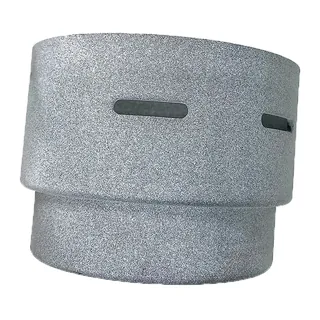
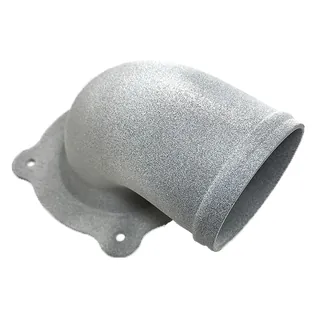
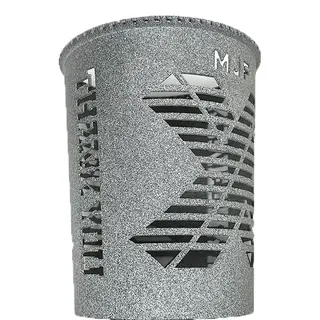
Matte and slightly grainy; the natural colour is grey. It takes black dye very well; chemical smoothing (a smooth, sealed surface) and vibratory smoothing are available.
Pricing
The price of PA12 is driven by material usage and the build space the part occupies. As a guide, around €0.40–2.00 per cm³ of part volume; the calculator shows the exact price.
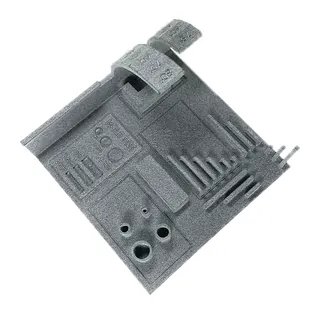
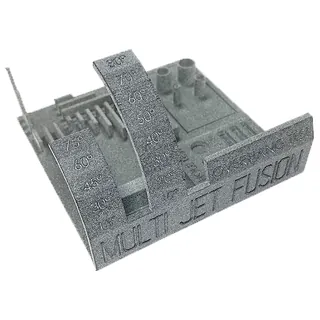
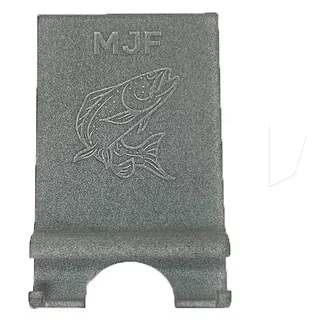
Parts by technology
PA12 Nylon – frequently asked questions
Is PA12 suitable for series production?
Yes. MJF and SLS produce tens or hundreds of parts in a single build – for small batches this is often cheaper than injection moulding, because no tooling is needed.
What is the service temperature of PA12?
Per datasheets – up to ~175 °C (without significant load). For long-term loading at high temperature, consult an engineer.
Is PA12 watertight?
PA12 absorbs little moisture, but because of micro-porosity, untreated thin features may let liquid through. For watertightness, we recommend chemical smoothing or impregnation.