- Home
- Technologies
- SLS 3D Printing (Selective Laser Sintering)
SLS 3D Printing (Selective Laser Sintering)
SLS (selective laser sintering) is a 3D printing technology in which a laser fuses polymer powder layer by layer. Parts are produced without supports and are strong and functional; SLS offers a large build volume and a wide choice of specialist materials.
A proven technology for functional nylon parts, tall parts up to 600 mm and specialist materials – ESD, Alumide, PA GF.
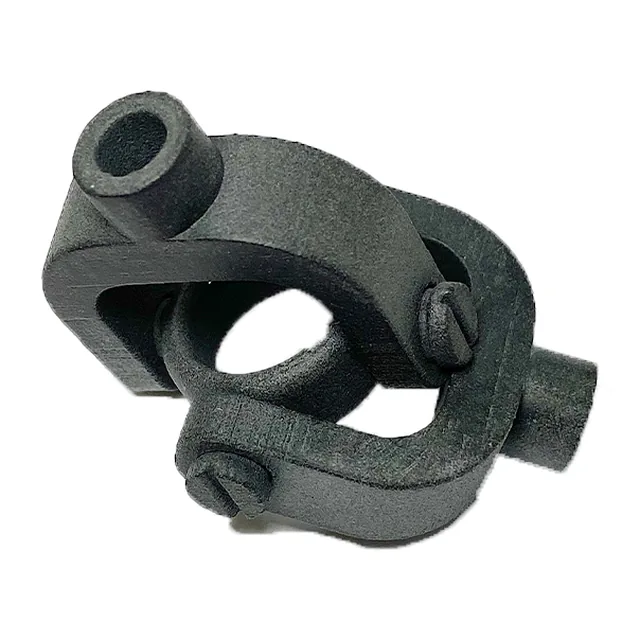
Choose SLS when you need
- Tall or long parts (up to 335 × 335 × 600 mm)
- Static-dissipative parts (PA11 ESD)
- Stiff parts with a metallic look (Alumide)
- Stiff parts with higher heat resistance (PA GF)
- Functional prototypes and small batches
Strengths
- No supports needed – design freedom
- Largest build volume among our powder technologies
- Wide choice of specialist materials
- Suited to batches – multiple parts per build
Limitations
- Slightly porous surface
- Large parts cost more
- Thin flat surfaces may warp
- Limited colour options
SLS materials
Properties from material datasheets. Click a material for full data and design recommendations.
Strong, versatile, ideal for batches
More flexible, more impact resistant
Dissipates electrostatic charge
Stiff, with a metallic look
Stiff and more heat resistant
Flexible, elastic, wear resistant
Property table for all SLS materials
| Property | PA12 (SLS) | PA11 (SLS) | PA11 ESD (SLS) | Alumide (SLS) | PA GF glass-filled (SLS) | TPU / TPE (SLS) |
|---|---|---|---|---|---|---|
| Technology | Selective Laser Sintering (SLS) | Selective Laser Sintering (SLS) | Selective Laser Sintering (SLS) | Selective Laser Sintering (SLS) | Selective Laser Sintering (SLS) | Selective Laser Sintering (SLS) |
| Tensile strength | 45 MPa | 48 MPa | 50 MPa | 48 MPa | 48 MPa | to be confirmed |
| Elongation at break | 28 % | 20 % | 27 % | 4 % | 5.5 % | 136 % |
| Tensile modulus | 1700 MPa | 1650 MPa | 1850 MPa | 3800 MPa | 3200 MPa | to be confirmed |
| Flexural strength | 42 MPa | 42 MPa | 56 MPa | 42 MPa | 42 MPa | to be confirmed |
| Service temperature (max) | 175 °C | 175 °C | 150 °C | 175 °C | 200 °C | 100 °C |
| Hardness (Shore) | — | — | 76D | 76D | 80D | 70–90A |
| Colours | white, grey, black | white, grey, black | grey, black | metallic grey | greyish / whitish | grey, black |
| Max. dimensions | 335 × 335 × 600 mm | 335 × 335 × 600 mm | 335 × 335 × 600 mm | 335 × 335 × 600 mm | 335 × 335 × 600 mm | 335 × 335 × 600 mm |
| Accuracy | ±0.3 mm or ±0.3 % | ±0.3 mm or ±0.3 % | ±0.3 mm or ±0.3 % | ±0.3 mm or ±0.3 % | ±0.3 mm or ±0.3 % | ±0.3 mm or ±0.3 % |
| Min. wall | 0.75 mm (down to 0.5 mm) | 0.75 mm (down to 0.5 mm) | 0.75 mm (down to 0.5 mm) | 0.75 mm (down to 0.5 mm) | 0.75 mm (down to 0.5 mm) | 0.75 mm (down to 0.5 mm) |
| Production time | up to 7 business days · express up to 4 | up to 7 business days · express up to 4 | up to 7 business days · express up to 4 | up to 7 business days · express up to 4 | up to 7 business days · express up to 4 | up to 7 business days · express up to 4 |
| Relative price | €€€€ | €€€€ | €€€€ | €€€€ | €€€€ | €€€€ |
| Datasheet | — |
Made with SLS
How SLS works
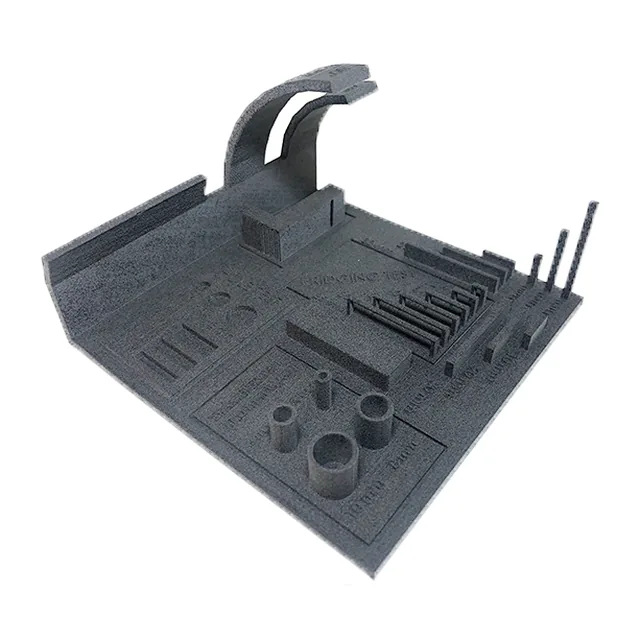
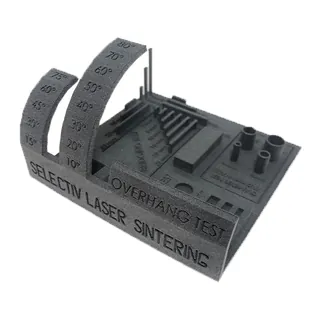
A thin layer of polymer powder is spread in a chamber heated to just below the melting point of the material. A laser beam traces the cross-section of the part and fuses (sinters) the powder. The platform lowers, a new layer is spread – and the process repeats until the part is complete. Unused powder supports the parts, so no support structures are needed.
SLS is one of the most widely used industrial technologies for both rapid prototyping and low-volume production (“rapid manufacturing”). The most common material is PA12 (nylon 12): slightly flexible in thin sections, strong in thicker ones.
When to choose SLS
- Tall or long parts – build volume up to 335 × 335 × 600 mm.
- Specialist materials – static-dissipative PA11 ESD, aluminium-filled Alumide, glass fibre-reinforced PA GF.
- Functional prototypes and batches – as with MJF, multiple parts are produced in one build.
Surface and finishing
The surface is smooth and slightly porous, with barely visible layer lines. Standard finishing (depowdering and bead blasting) is included. Black dyeing, spray painting, chemical or vibratory smoothing and threaded inserts are available.
Cost factors
- Size – parts larger than ~150 × 150 × 150 mm take up a lot of chamber space, so they cost more.
- Quantity – from 5 units (these can be different parts) the unit price can drop significantly.
Designing for SLS
- Minimum wall – 0.75 mm (down to 0.5 mm in places).
- Cavities – at least one 2–3 mm opening to remove powder.
- Moving parts – clearances of at least 0.5–1 mm, otherwise they may fuse together.
Finishing options
Standard finishing is included. Choose extras in the configurator – price and lead time update instantly.
Standard finish included
Removal of excess material and glass-bead blasting (powder technologies), support removal (SLA, FDM).
no extra time
Dip dyeing (black)
The part is immersed in a dye bath – an even, deep black that does not fill in fine details.
+1 business days
Spray painting
Priming and spray painting in the colour of your choice.
+3 business days
Chemical smoothing
The surface is smoothed chemically – lower roughness, easier to clean, a better sealed surface.
+2 business days
Vibratory polishing
Parts are ground in abrasive media – a uniformly smoother surface and rounded edges.
+1 business days
Threaded inserts
Metal threaded inserts are heat-set into prepared holes. Specify the quantity per part.
+1 business days
Thread tapping
Threads are cut directly into the plastic in prepared holes. Specify the quantity and thread size in the notes.
+1 business days
Sealing / lacquering
The surface is lacquered or impregnated – for tightness, moisture resistance and gloss.
+1 business days
SLS – frequently asked questions
What is SLS 3D printing?
SLS is selective laser sintering: a laser fuses polymer powder following the cross-section of the part, layer by layer. Unused powder supports the part, so no supports are needed.
Which SLS materials do you offer?
PA12, PA11, PA11 ESD, Alumide, PA GF (glass-filled) and TPU/TPE elastomer.
How large can SLS parts be?
Up to 335 × 335 × 600 mm. Larger parts can be split and joined – talk to an engineer.
How accurate is SLS?
Typical accuracy is ±0.3 mm or ±0.3 % (whichever is greater).